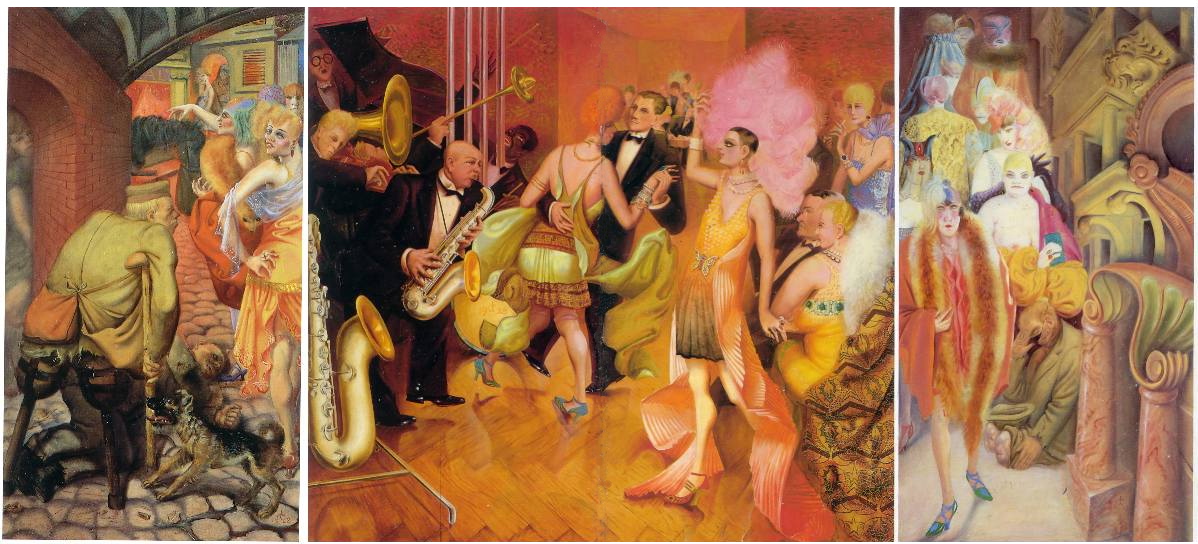
Otto Dix, "Metropolis", 1927-28
Otto Dix was a German painter and printmaker, who was a part of the Neue Sachlichkeit (New Objectivity) artistic movement. He born in Untermhaus, Germany. Through the nuclear and extended family unit he was exposed to art from an early age. For example, his mother, Louise Dix, was "A seamstress who had written poetry in her youth." He also frequented the art studio of his cousin, Fritz Amann, which cemented the young man's desire to be an artist. In addition, war also inspired him. In the First World War, he served from 1915 to 1918. Through his art he recounted the horrors of war, especially influenced by a "Recurring nightmare in which he crawled through destroyed houses."
The title of this piece is called "Metropolis". It was created sometime between the years 1927-1928.
The first consideration that must be given to this piece is in examining the size of each frame. Within the picture itself, there are three frames. The frame in the center is bigger than the other two. In fact, it is about the size of the other two frames put together. This places the viewer's focus on the central frame; Which in effect prioritizes both the viewer's attention and the order of importance of the frames.
The whole piece is named "Metropolis". Therefore, we conclude that each frame is a scene taking place in the same city. The picture in the central fame that commands our attention is located in a posh club of some kind. A retreat for the bourgeoisie. Appropriately, the scene is a lively one. There is music and dancing; Such is the life for the rich in every era. The women are dressed in the style of the day: 1920s Flapper. When we compare what is happening in this frame to the others, we see that this carefree attitude is rather a synonym for "Oblivious".
The other two frames represent what is happening outside. Perhaps directly outside of this club or in another place of the city. On the left, there is a man, disabled and probably homeless. There is also a man lying on the ground, presumably dead. Both the disabled man and the dead man are wearing clothes devoid of color. They are poor. They are likewise devoid of life, of the rich color that is used the paint the aristocrats. Seeming patrons of the club walk past the two men, one even turns back to them, with either a hint of a laugh and a smile or a look of disgust on her face. Either way, her tone is mocking. Oblivious.
The frame on the right is similar. People with colorful garb walk past a homeless man that has no legs. We do not see his face but the hands covering his visage say that is distraught. Yet no one pays attention. No one cares.
From the information in all of the frames, we can gather the sense of social responsibility, or lack of, in the bourgeoisie. They are concerned with nothing other than their own feelings. They can have a good time yet watch the world fall to pieces around them.
"Metropolis" is a prime example of the New Objectivity movement. It is Dadaist in its brutal, almost fatalistic, honesty about the nature of the class structure and the complete antipathy of wealthy classes. From a Nihilistic perspective, it unmasks the ugliness of society and the baseless "Morals" therein. In fact, just as Nietzsche sought to expose the anti-life values of Christianity, Dadaism seems to want to expose the anti-life sentiment of corrupt capitalism; a system that is not concerned with the greatest benefit of all humankind and one that does not mind turning the other cheek in the face of the underprivileged.

Your blog looks really great. You did the assignment right and more importantly it was interesting to read. After reading your post on Nietzsche I think you will be very interested in this week's lecture. Just to set the timeline straight with Dadaism, this movement developed before the Nazi movement picked up momentum. As revolutionary as dadaism was, it failed to strike a chord, or make a connection with the majority of the public, a common failing of artistic movements unfortunately, and the Nazis gained power in the 1930s. What you wrote about music is very interesting too. I am very envious, in a good way, of musicians who are able to display their talent almost instantly, if you ever saw the movie Amadeus this is very clearly shown. You should also read the book All that is Solid Melts Into Air by Marshall Berman who just died this past week. The quote by Ginsberg is in there, and he is very much influenced by the culture you are referencing. In a future lecture, I will try to show you how many of these German artists and intellectuals came to the U.S. in the 30s and 40s and I would argue had a great influence on the counter-culture that developed after.
ReplyDelete