Tuesday, December 3, 2013

The Work of Art in the Age of Mechanical Reproduction

"The uniqueness of a work of art is inseparable from its being imbedded in the fabric of tradition. This tradition itself is thoroughly alive and extremely changeable. An ancient statue of Venus, for example, stood in a different traditional context with the Greeks, who made it an object of veneration, than with the clerics of the Middle Ages, who viewed it as an ominous idol. Both of them, however, were equally confronted with its uniqueness, that is, its aura."
-Walter Benjamin

"The Great Dictator" starring Charlie Chaplin is one of the first known parodies of Adolf Hitler and the Nazi Party. However, it is important to note that the main star had not known of the atrocities of the war. According to an autobiography, the actor states that "He would not have made the film had he known about the actual horrors of the Nazi concentration camps". But it is perhaps better that he did not know, because this parody of the war gave a sharp contrast to its historical reality; One that ironically heightened its senseless violence and hate through folly. Although perhaps we can never know what it must have felt like to live through World War I and World War II, through art, whether painting, poetry, or film, we can vicariously experience something akin to the reality that those living during that time faced. Comedy is, though less vicarious, is often essential in communicating the past to the layman and is also used as a coping measure. 

Serious genres, on the other hand, can bring to life a more realistic version of the horrors of the wars; The ones researched by scholars and penned by survivors.

This is the paradigm shift that Walter Benjamin spoke of in "The Work of Art in the Age of Mechanical Reproduction". While he might not have thought favorably of a physical reproduction, the evolution of criticism from era to era of the same original piece of art is one way in which the original remains the same (Not counting dubbing/subtitles) but the response to the film changes. In fact, we could even say that there is an aura to the history itself, one that, given its removal in space and time from us, allows for re-interpretation, for better or worse. This is why there is everything from Holocaust deniers (Underestimating or even perhaps overestimating in some cases the number of deaths) to people who, although they may not have been around at that time, they have still been inspired by and create otherwise realistic depictions (In their art) of life back then based on their own research. 

It's clear that both history and art can transcend the time and space in which they were limited. There's been so many films in different genres based on WWI and II that they have become a part of our growing consciousness as people. It's also clear that on a mass culture level they represent how we feel about them as a collective, still sometimes for better or worse.  

From the moment it came out, I was a fan of Quentin Tarantino's Inglorious Basterds. I think the idea that film as a medium is so powerful it can rewrite and revision history as much as it can retell it, makes it a valuable tool, for better or worse depending on whose using it. In Inglorious, for instance, rather than being free to escape and commit suicide, Hitler is killed. I saw the movies in theaters. In the back of my mind while watching the film, the historical truth was in my mind. I thought, "Wait a minute. Well...I know what's going to happen." Obviously I got a nice surprise. I should have known Tarantino would have put his own spin on things.



Saturday, November 2, 2013

Weimar Constitution

Article 75 
A plebiscite can override Reichstag decisions only if the majority of enfranchised voters participate

According to Merriam-Webster, a plebiscite is a "A vote by which the people of a country or region express their opinion for or against an important proposal".

The function of the plebiscite is to balance out the power of the government. 

Since the representatives in the German government are not chosen from among the states (Like the American Congress), and thus do not represent the specific interests of states, the Plebiscite is supposed to endow the people, ideally, with the power to contests any measure that they are opposed to, as well as being able to vote in favor of any measure they are in proposition towards.

Regardless of the structure of government, it is always important to be free to speak out against policies of government, and also to be heard. These rights are thus important for humanity because they give the people the right to voice their opinion and be heard on matters that may directly or indirectly affect them. 

At the present time, I believe that U.S. laws that cover "Freedom of Speech" falsely masquerade themselves as honoring the same plebiscite code that the Weimar Constitution sought to create. However, the result is that even though there is a plethora of free speech on the subject, in the form of journals, blogs, social media, or any other form of public discourse, there is little that is done to actually ensure that a change will be made if the public does not agree with certain policies. What we have now is the facade of plebian represensation. 

I would say that we know that plebiscite is a right because the opposite course would be to allow a ruling government the ability to decide on things that could possibly alter their fate, in matters of war, finance, or other policy, without their consent. 

This has been the course of history as we know it. 

Article 142
The arts, science and instruction are free. State provides protection and participates in its cultivation.

I have always had a great admiration for Europe because of their education policy. For born and bred citizens of most nations in Europe, education is available free of charge. These countries seem to understand what is still unknown to my own: That we, the people, are the Human Capital that will make our nation grow. If we are not given the chance to become educated, we will not be able to compete with the world in terms of productivity and advancement. At the present time, there are many more people who are, as i've previously stated, taking from the system in the form of welfare, instead of giving to it. But I believe that if people were more prepared, from public school to university, they would be able to contribute more to their self growth, spiritually and financially, as well as helping their own nation to grow. 

Education itself is important for humanity, but first of all it is important for the individual. There are two ways that I usually think about such questions but here I feel that it is important to address the individual and the collective. Education is important for the individual because it will ensure that each of us has the capacity to be able to better compete with other individuals in our own nation for more lucrative opportunities. Education instills knowledge to people, such as if people knew more about class struggle throughout history I mentioned on Jinny's blog (About Luxemburg). 

Almost every continent and even nation has had their own struggle and from time immemorial there have always been rules about what one is entitled to based on their station (Wealth, family name) in life. 

Without that knowledge of the past we are a blank slate for exploitation. History made to repeat itself...

When we've made sure the individual has access to education, we are already securing the future of our nation, as we are building our human capital from within. 

The question of "How do you know they are rights?" is perhaps difficult to answer.

Friday, October 25, 2013

What Does the Spartacus League Want?

From dead machines assigned their place in production by capital, the proletarian masses must learn to transform themselves into the free and independent directors of this process. They have to acquire the feeling of responsibility proper to active members of the collectivity which alone possesses ownership of all social wealth. They have to develop industriousness without the capitalist whip, the highest productivity without slavedrivers, discipline without the yoke, order without authority. The highest idealism in the interest of the collectivity, the strictest self-discipline, the truest public spirit of the masses are the moral foundations of socialist society, just as stupidity, egotism, and corruption are the moral foundations of capitalist society.
~Rosa Luxemburg, from
What Does the Spartacus League Want?

Although in her ephemeral lifetime she construed a philosophy that was too subversive for the Germany of the early twentieth century, (Undoubtedly playing a role in her execution),  Rosa Luxemburg prophetically touched upon the still needed political reform of today. This passage is a call to the working class not to remain the puppets or "Dead machines" of the capitalist system but instead to learn how to become the machine themselves, or, as she says, the "Free and independent directors of this process". Those who have attained such wealth would then learn to maintain their station using the values opposite those of capitalist society. "Industriousness without the capitalist whip". "Highest productivity without slavedrivers". 

Luxemburg's stance against capitalist society is as evident as is her solution. She sees capitalism as a source of the weakening of the proletarian system, indeed of the proletariat himself/herself and thus a force of degradation and devaluation of human life. This harkens back to Nihilism in that its original thinkers believed the moral fabric society was void and that a life that was meant to be lived in content was more often spent in lifelong agony, despair, and human labor which only sated the pockets of the bourgeoisie (Representing the most uber form of amorality). A life meant to be lived became a life (lived) without meaning. Nihil.

As far as World War II itself, as are most wars, it was one presumably not only fought by the lower classes on the battlefield, but one whose preproduction labor (Such as in the making of weapons, in factories) also was fueled by the labor of the proletariat. Although the war may not have been started by the bourgeoisie 

The war did not voice the concerns of the people. Rather the war exploited the people and put them into danger as the close proximity of the violence reached the cities. 

These words as penned by Luxemburg remind me of the "Trickle down effect" theory, or even the image of one person's greatest being another person's ladder upwards, if those ahead of us are willing to bring us along for the ride. She speaks of solidarity in lieu of selfishness.  It is a lesson the world still has not learned.

If I have interpreted her words correctly, then I feel that I have a great example of how I was able to break away from the great machine that is capitalist society and to create my own, though still only growing, lucrative position in the world.

For about four years and six months I was a cashier at a drug store/pharmacy downtown. Long story short, the only reason I lasted so long there was because it was the only job that worked with my class schedule. 

Sometime around or after hitting the two and a half mark, I was certainly the proverbial disgruntled proletariat. I knew I was working towards something greater but my disappointment at my situation then could not be masked. But instead of wallowing in my disappointment, I decided to do something about it. 

I decided to start my own business. 

I opened a retail chain (Fashion) that did not last more than a year or so. But it gave me the drive I needed to keep going. I knew the path to freedom lied in the ability to be my own boss. In this economy, "You have to make your own job". That is my motto. 

So I networked with people, eventually being revisited by a lady who had seen me on and off at my job for the past year or so, and wanted to give me the opportunity to work in Social Media for a friend of hers, who is a mini celebrity of sorts (Producer, Nightclub Owner, Investor, etc...Pretty much a jack of all trades in the entertainment industry). 

Needless to say, I had already known the power of Social Media through the work I did for my own company, gathering more than four hundred souls to my Facebook page through various means, so I jumped at the chance to work for this person. 

After working for him for eight months, and then for two other companies in Social Media, and beginning my ascent further upwards by having finally worked for a company in my industry (Biology/Biotech), I can understand the power we have to shape our condition. 

Rosa Luxemburg speaks of learning to "Become" like the affluent in the sense that we learn their tools of the trade but do not adapt to their vices. Most people are complacent being a part of the machine. 

Facebook is the best example.

So much business potential lies in using Facebook as a means to market businesses and products...But most people simply use social networking sites as a means to keep in contact with family and friends, while, unbeknownst to them, they are a market to which different products and services are being targeted.  

Sunday, October 6, 2013

The Blue Angel

In the Blue Angel, the story revolves around two different yet important age groups. Young and old men. As is revealed to us by the end of the movie, those age groups overlap in their disposition towards the famous nightclub, the Blue Angel. No one can resist the charm of the place, and its lady dancers, especially not the star attraction: Lola (Played by Marlene Dietrich). Immanuel Rath is the local high school teacher who has taken it upon himself to chase out any of the young men from his class whom he first discovers at the cabaret. At first he believes the club is carnal attraction. Yet soon it is he, the intellectual, the erudite scholar, the "Professor" who has equally been drawn into the peepshow. 

There is one scene is particular where he is swooning to the high pitched voice of Lola as she serenades the crowd about "Falling in love again". In effect, he believes that she is singing to him. While Lola marries Immanuel Rath, a move that would not happen nine times out of ten in reality, she still retains her profession as a cabaret dancer. This causes the professor to develop deep-seated jealousies due to the sensual nature of her close proximity with her patrons. 

In the end, it is the resigned professor Rath who has taken up the role of clown in the travelling circus. He actually loses Lola due to his jealousy and ends up coming back to his hometown during their tour back. 

The scene with  the Professor at the nightclub as previously described shows man as stereotypically as they are still portrayed as the harborers of logic and reasoning and learning. Lola, on the other hand, is symbolic of the Biblical Eve, tempting man with her lustful persona; Bringing him down.  

As far as Nihilism is concerned, the Professor is brought down from a position of respectability to one of degradation. His downward descent was catalyzed by his own degradation of morals. It is the professor who allowed the Blue Angel, (Which is symbolic of the corrupted society), to corrupt him. 

From this we can ask questions such as, what is the value of the professor's learning if he was so easily corrupted in the end? Clearly the teacher had knowledge, which was enough to teach the next generation of young students (Or maybe not so much so since he could never get them to respect him) but not the logic and reasoning skills that go with being able to apply that knowledge, particularly in his own life. 

This scenario harkens back to Siddhartha, where the title character found himself among his father's traditions, that of the priests and other "Learned" men, yet it was so obvious that they did not have the experience to back up their merely meditated-upon truths. This seems to be the problem with the professor, who may have been more so on the Theory end of Praxis. 

Immanuel Rath is a stern teacher who can decipher the most complex of Shakespearean verse, at least on the surface. He is like a student who merely takes in what he learns, memorizes it, and regurgitates at least enough to get a good grade. Yet when he is asked what all of his lessons meant, can only freeze up. 

Immanuel has a lot of knowledge but no empirical, no direct experience applying that knowledge, which is rather useless.  

Saturday, October 5, 2013

Keine Zeit, Das Lila Lied, and Paragraph 175

Cabaret Songs

"In this day and age, you fall in love in the evening, are engaged at night,
and get married the next morning.
At noon you have a fight; by night you're divorced."

"Heut verliebt man sich abends, verlobt sich bei Nacht und vermaehlt in der Frueh sich zufriede und am Mittag da hat man bereits sich verkracht und am Abend ist man wieder geschieden."
~ No Time (Keine Zeit)

First of all, I can start off by noting how applicable the entire song is. They are relevant as much now as they were in the 1920s apparently. When I hear this line in particular I think of the stories of famous people who have courted for a few weeks or months and then decide to get married. Nearly a fortnight has passed and they're ready to get hitched. The words seem to say something about how hopefully and hopelessly foolish and vulnerable the human heart is or can be. The lyrics suggest how naive people can be.

In its entirety, the song is ironic. It suggests that people live their lives as if they believe their is "No time". People are so concerned about living their lives to the fullest that they make decisions in hastes. Yet those decisions can ultimately do more to prolong their pain their pleasure. So it's foolish to live life on a fast track plan. "No time" in this sense seems to suggest reckless endangerment rather than a sense of abandon and adventure.  

"What makes them think they have the right to say what God considers vice
What makes them think they have the right to keep us out of Paradise"

"Was will man nur? Ist das Kultur,
da jeder Mensch verpönt ist,
der klug und gut, jedoch mit Blut
von eigner Art durchströmt ist,"
 ~ The Lavender Song (Das Lila Lied)

Again, it is very interesting how closely linked the past is to the present. This time we have a glimpse into the hardships faced by the LGBT community in the past. "If we resist, prison awaits so our love dares not speak its name" makes me recall that I have heard stories of homosexuals (Men) being jailed in the past. Someone commented on the video for this on Youtube that, if what they went through in the past is still being played out in the American courts today, how much have we really changed in nearly a century of world policy? It is a thought provoking question. There are some social norms that have changed from time to time, like the age of marriage and conception. But then there are others that we as a global culture have been dealing with for a much longer time... Such as LGBT equality.

Paragraph 175

"Penal servitude up to 10 years or, where there are mitigating circumstances, imprisonment of not less than three months shall apply to: (1) a male who, with violence or the threat of violence to body and soul or life, compels another male to commit a sex offense with him or to allow himself to be abused for a sex offense; (2) a male who, by abusing a relationship of dependence based upon service, employment or subordination, induces another male to commit a sex offense with him or to allow himself to be abused for a sex offense; (3) a male over 21 years of age who seduces a male person under twenty-one years to commit a sex offense with him or to allow himself to be abused for a sex offense; (4) a male who publicly commits a sex offense with males or allows himself to be abused by males for a sex offense or offers himself for the same."

Paragraph 175 seems to relate to the old German song, "Das Lila Lied", a.k.a. The Lavender Song. Whereas the former describes the laws that were enacted during Nazi Germany in order to prevent the spread of the so-called perversity of homosexuality, the latter is a protest song that was written in the same era. I imagine that during this time the cabaret was not only a place to which men would go in order to sate their sexual fantasies and desires, but also a place to which one might find the transexuals and homosexuals of the day. Since from a Nihilistic perspective, the Blue Angel was a nightclub symbolic of vice and a corrupting force of the intellectual, I wonder what stance Nihilism might have on homosexuality? That's an interesting question...

One of the finer points of Nihilism seems to be that society ordained what the individual thought of as morally right and wrong. Yet society, as we've seen through the paintings of Otto Dix's "Metropolis" is also feverishly hypocritical. I think the Nihilists would favor a version of homosexuality that fits in with the epic struggle of Siddhartha; One that is prevented from achieving its life goals towards Brahma by being constantly brought down by society's model man or Atman. Just like the Dadaists, who favored giving their own meaning to things, giving new concepts to old words and ideas, this passage seems to demonstrate how vacuous and nihilistic, indeed "Anti-life" were the laws and punishments against homosexuals and other transgressive
sexual "deviants" in Nazi Germany.

Thursday, September 26, 2013

The Cabinet of Dr. Caligari, Erich Fromm, etc etc

In analyzing the Cabinet of Dr. Caligari, I would like to draw upon two quotes from the biography of Erich Fromm. Both quotes reveal the depth of his research as well as profound insight into the problems of modern man. 
One of the first observations that can be made from the Cabinet of Dr. Caligari is the absurd and nightmarish ambiance of the fictional village, Holstenwall. Cinematically representing the artistic inspiration of the time, the film draws upon the realms of surrealism to be found in the German Expressionism and New Objectivity movements. 

It is quite obvious that we are not in the real world but in a dream. In the same way a dream never completely accurately recalls a place you might have lived in the past, but more often than not takes bits and pieces from your memory, of where you live now and perhaps a few other places you lived before, the village of Holstenwall is a jumbled mass of unrealistic and unproportional architecture. 

The central theme of the film seems to be (in)sanity. The question being, who is (in)sane? Is it the patient (Francis) or the doctor (Dr. Caligari)? 

In fact, many have dissected the plot further and believe the doctor is a symbol of the greater authority in society; And therefore the patient a symbol of the individual who is subservient to the authority figure. 

The warring ideals then become: Is the patient delusional? Are his experiences in fact nonexistent? Is it in fact the doctor who, though charged with overseeing and medicating society, is in fact poisoning society...Himself being insane? 

...Or, is it the patient who is insane? Perhaps the doctor is the omniscient "God-Father", who knows what is best for his children...Who can see what problems they have and how best to treat them? 

One of the most interesting things about the Cabinet of Dr. Caligari is the influence it seems to have had on the psychological thriller/mindtrip genre, especially those whose basis is the question of (in)sanity, and even more so those who question insanity and/or personal freedom in a tightly controlled-by-the-government world. If the influence of this film is thus, then every film from The Matrix to Oblivion to Existenz to Total Recall to Requiem for a Dream to The Island to Shutter Island to Inception, etc etc has been subconsciously influenced by the Cabinet of Dr. Caligari. 

"Fromm hoped to show the way to a psychologically balanced "sane society."

 One of the academic pursuits of Erich Fromm was in:

"Analys[ing] the tendency of modern emancipated man to take refuge from his new insecurities by turning to totalitarian movements such as Nazism."

This fits in very well with a theory I have that in some ways even our culture today, as multicultural as it is, is not immune to the effects of Nazism. 

It is not that I believe that our culture is necessarily racist; Not in a eugenics program sense. Rather, I see it as a form of Social Contract. Whereas Rousseau devised a Social Contract with a presumed beneficial mutual relationship between civilians (in cooperation with their government) and governments (in their dedication to serve the people), the Social Contract now has an inverted meaning. 

The Social Contract that exists now is a mutual agreement between the people to maintain whatever status quo has been mandated to them due to their race or sex or other demographic factors. Maintaining this status quo is in effect seen as a maintaining the order in our society. 

I will use famous people of African descent as an example. 

In my opinion, they are merely allowed to become celebrities if, and only if they, on more occasion than not, portray a negative stereotype that is then used to represent all people of African descent. 

The stipulation of their becoming a celebrity is then the "Selling out" of their humanity and the embracing of their socially contracted "Role". 

In this way, Nazism has taken a new form in America. Since ours is a changing face of diversity, we need a model of Nazism (edit: 2021. Wtf was I thinking here lol. Mega eyeroll.) that isn't racist but instead works within the current social paradigm. We need a face of Nazism that complements diversity.

Perhaps my analysis of these things merely uncovers the unfortunate nature of the "Way things are". But I think there is a lot more than merely the surface of things we see, especially concerning the rich and famous celebrity culture. Stereotypes that people are comfortable with are handpicked from out of the masses

Friday, September 20, 2013

Siddhartha

"What seems to separate the two is that Siddhartha has lived the life of a sinner, and through this experience as well as his religious experiences he has learned and experienced the oneness of the universe"
~ Barry Murdaco

 "Listen well, my dear, listen well! The sinner, which I am and which you are, is a sinner, but in times to come he will be Brahma again, he will reach the Nirvana, will be Buddha

... all sin already carries the divine forgiveness in itself, all small children already have the old person in themselves, all infants already have death, all dying people the eternal life.  

...death is to me like life, sin like holiness, wisdom like foolishness 

... I needed lust, the desire for possessions, vanity, and needed the most shameful despair, in order to learn how to give up all resistance, in order to learn how to love the world, in order to stop comparing it to some world I wished, I imagined, some kind of perfection I had made up, but to leave it as it is and to love it and to enjoy being a part of it."
~Siddhartha

"Sinner" is a word that evokes powerful feelings in the West. I want to make a few distinctions between the Eastern and Western concept of sin so that we can understand these differences. 


First of all, the Western concept of "Sin", which is influenced by Christianity, is linked to the concept of "Worldliness". Basically, the idea is that we, man, are born with Original Sin. This is a predisposition to err on the side of bad that was brought into the world through the disobedience of Adam and Eve in the Garden of Eden.  Thus we are in an eternal struggle against this inherent evil. Those who strive to keep this original sin at a distance (By following God's Commandments) are called "Righteous". In Christian philosophy, they have attained "Brahma" by not sinning.     

However, taking a passage from Siddhartha: 

"The sinner, which I am and which you are, is a sinner, but in times to come he will be Brahma again, he will reach the Nirvana, will be Buddha"

We can see that the Eastern and Western concepts of Sin are vastly different. 

The best visual representation to understand the Eastern concept of Sin is the Ying Yang. It is a symbol of opposites. Good and Evil. Dark and Light. These opposites share an equal space. Both make nature complete, giving balance to the universe.  

This applies to the Buddhist concept of Sin because it intuits the full circle aspect of life. That is, there is a directly proportional relationship between the path of the Sinner, aka Atman (Man) and the path of the Brahma (God, or rather the God the Atman becomes through his journey). The process of going from one to another is catalyzed by experience. (In fact, it is more of a continuum than two separate paths. This what Siddhartha means by 'all small children already have the old person in themselves, all infants already have death, all dying people the eternal life')    


"I needed lust, the desire for possessions, vanity, and needed the most shameful despair, in order to learn how to give up all resistance, in order to learn how to love the world, in order to stop comparing it to some world I wished, I imagined, some kind of perfection I had made up, but to leave it as it is and to love it and to enjoy being a part of it."

Whereas Christianity more often preaches total avoidance of Sin, Eastern philosophy understands it as a necessary feature of life. In fact, there is no "Sin", no vice of life in the truest form except that which separates the Atman from his path in life.

Buddhism seems very neutral when it comes to designating an act a Sin. There do not seem to be many "Thou Shalt Nots". It is primarily about the individual's path; Which can change from one person to the next. It is only through experiencing life as an Atman that we can become Brahma. 

Ying and Yang. Each a necessary force of life.  

My own example of Brahma and Atman. 

I think this is best explained by saying that most of us cannot fathom what it is like to be homeless. I mean homeless in the sense of living through years of desperation. We can't fathom what it's like to be hopeless. Most of us have never found ourselves on the downside of low. 

I think there is a real barrier in perception between those who have always been pretty much financially stable and those who have never known stability. (Being broke for a little while doesn't count.)

I think it would be very much like discovering Brahma through Atman if more of us were aware of what life looks like through the eyes of the homeless by actually experiencing homelessness. 

Note that most of the negative comments on the homeless are usually by those who haven't been there themselves, despite how much they utter that the opposite is true.  

Furthermore, Eastern religion seems to lack a deity figure. The Buddha is more of an example of the model "Man turned God" than an object of deification. In this way, each follower can become his or her own God. Within the self is the potential to damn or save one's own soul; And not in the hands of an omnipotent and omniscient creator. Therefore, the only one who can truly know if you've come to the goal of your life is you.

Saturday, September 14, 2013

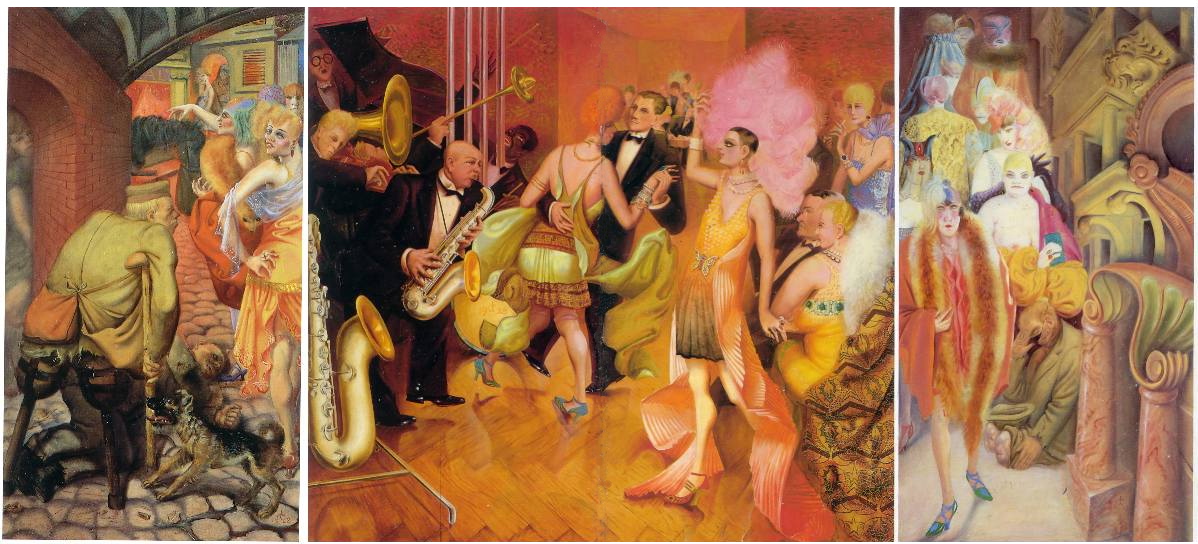
Otto Dix, "Metropolis", 1927-28

Otto Dix was a German painter and printmaker, who was a part of the Neue Sachlichkeit (New Objectivity) artistic movement. He born in Untermhaus, Germany. Through the nuclear and extended family unit he was exposed to art from an early age. For example, his mother, Louise Dix, was "A seamstress who had written poetry in her youth." He also frequented the art studio of his cousin, Fritz Amann, which cemented the young man's desire to be an artist. In addition, war also inspired him. In the First World War, he served from 1915 to 1918. Through his art he recounted the horrors of war, especially influenced by a "Recurring nightmare in which he crawled through destroyed houses."


The title of this piece is called "Metropolis". It was created sometime between the years 1927-1928.

The first consideration that must be given to this piece is in examining the size of each frame. Within the picture itself, there are three frames. The frame in the center is bigger than the other two. In fact, it is about the size of the other two frames put together. This places the viewer's focus on the central frame; Which in effect prioritizes both the viewer's attention and the order of importance of the frames.

The whole piece is named "Metropolis". Therefore, we conclude that each frame is a scene taking place in the same city. The picture in the central fame that commands our attention is located in a posh club of some kind. A retreat for the bourgeoisie. Appropriately, the scene is a lively one. There is music and dancing; Such is the life for the rich in every era. The women are dressed in the style of the day: 1920s Flapper. When we compare what is happening in this frame to the others, we see that this carefree attitude is rather a synonym for "Oblivious".

The other two frames represent what is happening outside. Perhaps directly outside of this club or in another place of the city. On the left, there is a man, disabled and probably homeless. There is also a man lying on the ground, presumably dead. Both the disabled man and the dead man are wearing clothes devoid of color. They are poor. They are likewise devoid of life, of the rich color that is used the paint the aristocrats. Seeming patrons of the club walk past the two men, one even turns back to them, with either a hint of a laugh and a smile or a look of disgust on her face. Either way, her tone is mocking. Oblivious.

The frame on the right is similar. People with colorful garb walk past a homeless man that has no legs. We do not see his face but the hands covering his visage say that is distraught. Yet no one pays attention. No one cares.

From the information in all of the frames, we can gather the sense of social responsibility, or lack of, in the bourgeoisie. They are concerned with nothing other than their own feelings. They can have a good time yet watch the world fall to pieces around them.

"Metropolis" is a prime example of the New Objectivity movement. It is Dadaist in its brutal, almost fatalistic, honesty about the nature of the class structure and the complete antipathy of wealthy classes. From a Nihilistic perspective, it unmasks the ugliness of society and the baseless "Morals" therein. In fact, just as Nietzsche sought to expose the anti-life values of Christianity, Dadaism seems to want to expose the anti-life sentiment of corrupt capitalism; a system that is not concerned with the greatest benefit of all humankind and one that does not mind turning the other cheek in the face of the underprivileged.  

Friday, September 13, 2013

Dada Manifesto

One of the first things I noticed about the “Dada Manifesto” is its sheer and utter honesty. It reminds me of two free form styles of writing, one known as “Free Verse”, the other called “Stream of Consciousness”. The latter is more of a way of letting the words flow without trying to control them or their meaning. However, both styles are related to a sense of freeing one's self from poetic norms.

The tradition can be traced back to the Beat Generation, specifically in writers like Allen Ginsberg.

An excerpt from Allen Ginsberg's Howl:

“I saw the best minds of my generation destroyed by madness, starving hysterical naked,
dragging themselves through the negro streets at dawn looking for an angry fix,
angelheaded hipsters burning for the ancient heavenly connection to the starry dynamo in the machinery of night”

Ironically one of my favorite poets/songstresses employs this style (Patti Smith).

Patti Smith's Babelogue (From the album 'Easter'):

"I haven't fucked much with the past, but I've fucked plenty with the future. Over the skin of silk are scars from the splinters of stations and walls I've caressed. A stage is like each bolt of wood, like a lock of Helen, is my pleasure. I would measure the success of a night by the way by the way by the amount of piss and seed I could exude over the columns that nestled the P.A. Some nights I'd surprise everybody by skipping off with a skirt of green net sewed over with flat metallic circles which dazzled and flashed. The lights were violet and white. I had an ornamental veil, but I couldn't bear to use it. When my hair was cropped, I craved covering, but now my hair itself is a veil, and the scalp inside is a scalp of a crazy and sleepy Comanche lies beneath this netting of the skin. I wake up. I am lying peacefully I am lying peacefully and my knees are open to the Sun. I desire Him, and He is absolutely ready to seize me. In heart I am a Moslem; in heart I am an American; In heart I am Moslem, in heart I'm an American artist, and I have no guilt. I seek pleasure. I seek the nerves under your skin. The narrow archway; the layers; the scroll of ancient letters. We worship the flaw, the belly, the belly, the mole on the belly of an exquisite whore. He spared the child and spoiled the rod. I have not sold myself to God."


The quote I chose from the Dada Manifesto is:

“I don't want words that other people have invented. All the words are other people's inventions. I want my own stuff, my own rhythm, and vowels and consonants too, matching the rhythm and all my own.”~ Hugo Ball

In essence, this is the meaning of Dada. The word itself is nonsense. It is an “International word” whose meaning changes from country to country; And from person to person. Basically, “Dada” can mean anything you want it to. The artist is the creator.

The repression of art by the Nazi regime indubitably helped to create this sentiment. Those artists affected by World War I and II went on a quest to re-discover who they were. This time they didn't have the proverbial Big Brother breathing down their shoulder, telling them how they could feel and how they could express that feeling through their art. Creating their art and the philosophical foundations on which their movement stood was like learning to walk again. Learning to think again. Becoming human again.

Almost as a rebellious afterthought, the Dadaist sought to discombobulate the foundations of art in theory and practice and to piece it back together in a manner suiting the individual (As he or she wanted). Therefore, as no two people have the same fingerprint, the meaning of Dada literally changed from one person to another.

In fact, if there is one unifying theme that all of the Dada artists have in common, it is that they sought to convey a message; Very often a political one. Many Dada works are a scrapbook-like collection of cut-out words and images, rather than and in comparison to the expertly crafted and detailed works in the other artistic genres of their day, such as Expressionism, Realism, and New Objectivity.

This quote reminds me of why I admire non-carbon copy art, especially music. I love the idea of feeling another person's experiences through their words and music. If there is a lack of experimentation in music, such as in the oversexualized or watered down genres that are popular on a mainstream level, there is an almost a numbing effect. We listen to them but we don't feel them. Songs go in one ear and out of the other.

Nowadays, a lot of music is carbon copy because it can be easily marketed to the masses. Obviously there are many exceptions. This is just a generalization. But I also think it used to be more true a few decades ago than it is now. (Experimental music is more lucrative now).

I can't remember their name, but I remember hearing a story about a music executive that listened to a band, noted its Heavy Metal sound and wanted to bring them in for a record deal. But upon seeing that they were of African descent took back the decision because he didn't know how to market them.

The Music industry is still in some ways based on its own set of Classical notions; That there are certain types of people who listen to and make certain types of music and that music that sells can only be made in a prescriptive formulaic way (Verse, Chorus, Bridge, Chorus, etc).  

Tuesday, September 10, 2013

German Society

According to the CIA World Factbook, Germany has a very low population growth rate at about -0.19%, placing it in 212th place in the world. Although the population numbers about 81,147,265 million people as of July 2013, placing the county in 16th place in the world, the contraceptive prevalence rate between women aged 18-49 is 66.2%. The contraceptive rate of a nation is an “Indicator of health services, development, and women’s empowerment. [But] it is also useful in understanding, past, present, and future fertility trends, especially in developing countries.”

Germany also only spends roughly 5.1% of its GDP on Education. Another 11.6% is given to Health Expenditures. 8.5% of its youth workforce is unemployed (Ages 15-24). Also, the population spends an average of 16 years in school (School Expectancy). But ages 15 and over can read and write(99%).

The ethnic makeup is 91.5% German.
The religious makeup is Protestant 34%, Roman Catholic 34%, Muslim 3.7%, unaffiliated or other 28.3%.
There is 100% Sanitation and Clean Drinking Water in Rural and Urban areas.

Christianity as Antiquity


“Christianity as antiquity.-- When we hear the ancient bells growling on a Sunday morning we ask ourselves: Is it really possible! This, for a jew, crucified two thousand years ago, who said he was God's son? The proof of such a claim is lacking. Certainly the Christian religion is an antiquity projected into our times from remote prehistory; and the fact that the claim is believed - whereas one is otherwise so strict in examining pretensions - is perhaps the most ancient piece of this heritage. A god who begets children with a mortal woman; a sage who bids men work no more, have no more courts, but look for the signs of the impending end of the world; a justice that accepts the innocent as a vicarious sacrifice; someone who orders his disciples to drink his blood; prayers for miraculous interventions; sins perpetrated against a god, atoned for by a god; fear of a beyond to which death is the portal; the form of the cross as a symbol in a time that no longer knows the function and ignominy of the cross -- how ghoulishly all this touches us, as if from the tomb of a primeval past! Can one believe that such things are still believed?”

It's very interesting that a great many philosophers state the obvious. Therefore, their insights are profound...Yet obvious at the same time. Or maybe not obvious...But common sensical in a way that is perhaps too profound for most, and thus makes it less obvious. I don't understand how a single religion, and not even the oldest, could have mesmerized the imaginations of people for so long that it is accepted as the irrefutable truth. Nietzsche says of Christianity and its spiritual tenets, “The fact the claim is believed- whereas one is otherwise so strict in examining pretensions” is an unthinkable hypocrisy. I don't disagree. “A god who begets children with a mortal woman” is a recurring theme is almost every mythology around the world. Yet stories of Hercules are relegated to fiction. Creation stories, dubbed “Myths” also exists from around the world. For example, in the Roman writer Ovid's Metamorphses, in the First Book after an Adam and Eve-like pair named Deucalion and Pyrrha have suffered a flood of Biblical proportions:


“They [descend] the steps, covered their heads and loosened their clothes, and threw the stones needed behind them. The stones, and who would believe it if it were not for ancient tradition, began to lose their rigidity and hardness, and after a while softened, and once softened acquired new form. Then after growing, and ripening in nature, a certain likeness to a human shape could be vaguely seen, like marble statues at first inexact and roughly carved. The earthy part, however, wet with moisture, turned to flesh; what was solid and inflexible mutated to bone; the veins stayed veins; and quickly, through the power of the gods, stones the man threw took on the shapes of men, and women were remade from those thrown by the woman.” 
 
This passage explains how, after the Flood, Deucalion and Pyrrah create more human beings by "Throwing the stones of their mother behind the back". 

I will admit that I count among Ovid's Metamorphoses one of the earliest recollections of "Religious experiences" of my youth. I knew of the Bible, but the work of Ovid and other similar tales like the Epic of Gilgamesh really opened my mind to the powerful imagery of the creation of the earth and the life of early man that is found in all cultures. 

One tribe in Africa may have hundreds or thousands of such tales or revisions upon an original tale. According to the Boshongo(A Bantu tribe): 
"In the beginning there was only darkness, water, and the great god Bumba. One day Bumba, in pain from a stomach ache, vomited up the sun. The sun dried up some of the water, leaving land. Still in pain, Bumba vomited up the moon, the stars, and then some animals: the leopard, the crocodile, the turtle, and, finally, some men, one of whom, Yoko Lima was white like Bumba." For more stories, http://www.mythome.org/creatafr.html .

The point is that all of the scholarship that is given to academia, especially the experimental methods of Science, is not given to Christianity. Perhaps to its history as a religious institution, but not to its spirituality. We accept that other religions, though we respect them, are largely based upon pseudoscience; Based on things that could have never been, although they make good material for Sci Fi/Fantasy. But Christianity is always considered infallible.